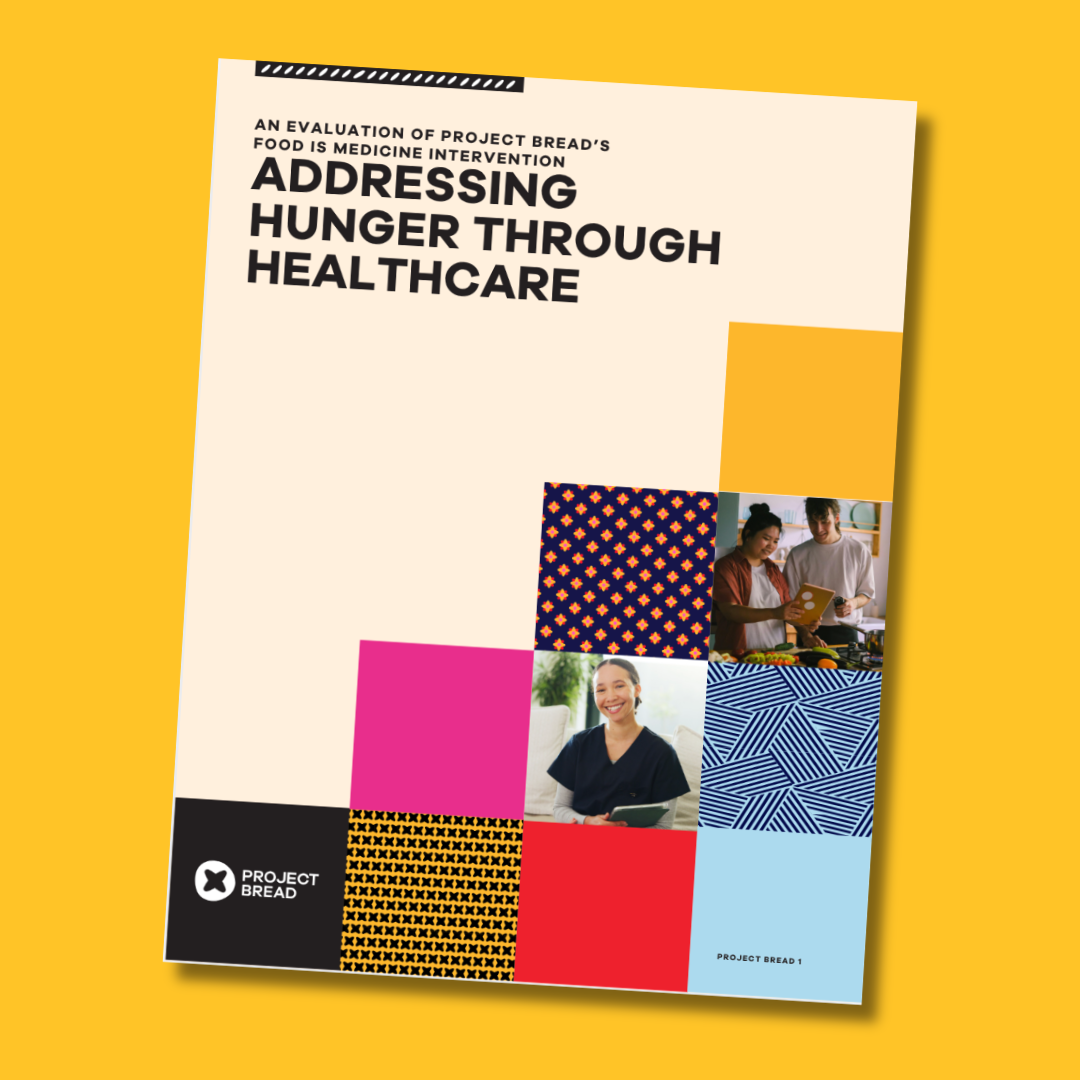
Food is Medicine: Study Finds Project Bread's Healthcare Partnerships Program Improves Food Security
Olivia Deng

When Emily Cabrera, Nutrition Services Coordinator at Project Bread, picked up the phone one morning, she found herself talking with a family in Lowell that was trying to stretch every dollar to feed seven people, including five children.
The father had been struggling to get enough hours at work. The family had recently learned that their SNAP benefits would be reduced. With five children ranging from a newborn to 10 years old, the family was concerned about keeping food on the table during an increasingly difficult time. That is, until they were referred to Project Bread’s Healthcare Partnerships Program, where they shared their struggles affording enough food, and got exactly the help they needed.
As part of her work, Cabrera often has conversations like this. Some families are navigating reduced work hours. Others are managing chronic health conditions while trying to afford healthy food. People across Massachusetts are worried about affording food for their household, especially when some members have specific dietary needs.
A previous participant in Project Bread's Healthcare Partnerships Program, who we’ll call W, faced this challenge after becoming homeless. After meeting with a hospital navigator to discuss her specific dietary restrictions and housing situation, W learned about how the program provides grocery gift cards on a monthly basis.
Food insecurity affects hundreds of thousands of families across Massachusetts. For people living with chronic health conditions, difficulty affording food can make it harder to manage their health, creating additional challenges for patients and healthcare providers alike.
Experiences like these are at the center of our new Healthcare Partnerships Report, which brings together five years of research on our Flexible Services Program. Our Healthcare Partnerships Program serves MassHealth patients with chronic health conditions and food insecurity, who are referred to Project Bread by their healthcare providers.
Between 2020 and 2024, Project Bread’s Flexible Services Program successfully served 15,986 patients.
The report examines what happens when healthcare providers identify patients experiencing food insecurity and connect them with food and nutrition support. In other words, we’re discovering the results of treating food insecurity as a health condition. Drawing on program evaluations, partner data, cost analyses, and client feedback collected between 2020 and 2024, the research explores how those connections affect food security, health outcomes, healthcare utilization, and patient well-being.
Bringing Food and Healthcare Together
Recognizing the connection between food and health, MassHealth launched the Flexible Services Program in 2020 through its federal Section 1115 Demonstration Waiver. The initiative allowed Accountable Care Organizations to address health-related social needs, including food insecurity. When MassHealth sought community organizations to help deliver those services, Project Bread expanded its work with healthcare providers by developing a comprehensive nutrition support program for eligible patients.
Each participant entering Project Bread's program is paired with a Nutrition Services Coordinator who begins by identifying barriers to accessing healthy food. Together, they work 1:1 to develop a personalized service plan that may include monthly food vouchers, kitchen supplies, nutrition counseling with a registered dietitian, cooking classes, and referrals to Project Bread's FoodSource Hotline for SNAP enrollment assistance. Participants choose the services that best meet their needs.
No two days look exactly alike for Cabrera. "My typical day varies," she said. "It can be from helping new members start services with us at Project Bread. It can also be helping members with our digital cards, checking emails, and staying in touch with ACOs and healthcare."
She currently supports about 400 clients, balancing new enrollments with follow-up calls throughout each participant's six-month enrollment.
Meeting People Where They Are
The program is designed to remove barriers between people and the food support they need. Our team of experts, like Cabrera, respond to each participant’s specific needs and circumstances rather than offering a single solution for everyone.
This flexibility made a meaningful difference for W. While staying in a homeless shelter, she managed a digestive condition that limited what she could eat.
"Once I finally was able to access the benefit of the Healthcare Partnership Program, it was nicer because I had more choices, so I wasn't restricted to what was offered through the shelters or the food pantry…I could buy more than what was given to me," she said.
The program also provided kitchen supplies that became especially useful after she moved into housing. "I was able to get the blender, which was nice," W said. "I do better with softer food and liquefied food."
Cabrera sees that same need for individualized support across the hundreds of clients she serves.
"The most impactful thing about my job is to make sure that our families are getting the food that they need, the kitchen supplies that they need, and also any referrals that they may need for additional support," she said.
She believes the program matters because many households are facing difficult circumstances. In W’s case, her immigration status means that she is not eligible for SNAP benefits, making food vouchers from the Healthcare Partnerships Program the only help available for W to be able to afford the foods that fits her needs.
"This program matters because a lot of families are facing the crisis of not being able to provide enough food for themselves or for their families," Cabrera said. "So this program is usually their ultimate source to have a nutritional meal."
Five Years of Findings
Between 2020 and 2024, MassHealth's Flexible Services Program served more than 44,000 members across Massachusetts. Project Bread supported 15,986 of those participants, representing approximately 36 percent of everyone served through the statewide initiative during that period. What began as a partnership with one Accountable Care Organization expanded into a statewide network that included seven ACO partners and more than 50 health centers and physician groups.
The report found that the program reached a diverse population across Massachusetts. Participants ranged in age from infants to adults approaching retirement age, with nearly 29 percent of clients being children. Services were delivered in multiple languages, including English, Spanish, Haitian Creole, Cape Verdean Creole, and others, helping ensure participants could receive support in their preferred language.
Nearly every participant received food vouchers, while most also received kitchen supplies. Some participated in nutrition counseling or cooking classes, and others received referrals to our FoodSource Hotline for SNAP enrollment assistance.
Call or text our FoodSource Hotline at 1-800-645-8333 for food assistance
Measuring the Impact
After participating in the program, clients reported greater food security, increased fruit and vegetable consumption, stronger confidence in their nutrition knowledge, and improved ability to prepare healthy meals. More than 9 in 10 participants said the program improved their overall health, and more than 9 in 10 reported it improved their ability to prepare healthy meals.
The report also found that participants who received nutrition education alongside food vouchers and kitchen supplies experienced greater improvements than those who received fewer services. They reported greater gains in fruit and vegetable consumption, self-reported health, physical health, and confidence in their nutrition knowledge, suggesting that combining food assistance with nutrition education can strengthen outcomes over time.
16,000
MassHealth Patients served
9 in 10
participants said the program improved health
The findings reinforce observations made by Project Bread throughout the first five years of the program.
"During the first five years of our program, we served nearly 16,000 MassHealth patients," Siller said. "In drawing on data from those patients, we found that access through the healthcare system and food and nutrition resources has benefits that extend far beyond just food access."
Participants in our program have reported improved food security, healthier eating habits, and greater confidence in nutrition knowledge. Many also say they are better able to prepare healthy meals tailored to their health conditions and feel more connected to their healthcare providers after taking part in our Healthcare Partnerships Program.
“During the first five years of our program, we served nearly 16,000 MassHealth patients. In drawing on data from those patients, we found that access through the healthcare system and food and nutrition resources has benefits that extend far beyond just food access.”
Laura Siller, Senior Director of Research and Evaluation at Project Bread
Participants in our program have reported improved food security, healthier eating habits, and greater confidence in nutrition knowledge. Many also say they are better able to prepare healthy meals tailored to their health conditions and feel more connected to their healthcare providers after taking part in our Healthcare Partnerships Program.
Benefits Beyond the Grocery Store
The report also points to improvements that extend beyond participants' kitchen tables.
One healthcare partner found that participants with uncontrolled Type 2 diabetes, experienced the greatest improvements in their A1c levels* after six months in the program. Another partner reported lower healthcare costs among participants, with an estimated annual reduction in total cost of care of more than $10.35 million across a cohort of 1,629 members. A separate partner also reported reductions in emergency department visits and associated cost savings now that patients have regular access to their most basic need—food.
Participants described benefits that could not always be measured in claims data alone.
For W, having access to food that met her dietary needs while she was unable to work provided stability during an uncertain and stressful time.
"The most impactful [aspect was] having a resource that I really needed when I wasn't making money," she said. "And that was also helpful given how restricted my diet has been."
The report also found that nearly 8 in 10 participants said the program strengthened their relationship with their healthcare provider. Follow-up surveys conducted after the program ended suggested that many participants continued to use the kitchen supplies they received and remained connected to nutrition resources, including SNAP, where eligible.
*The A1C test measures your average blood sugar levels over a 3-month period. The higher the percentage, the higher your average blood sugar levels have been.
Looking Ahead
On January 1, 2025, MassHealth transitioned the Flexible Services Program to the Health-Related Social Needs (HRSN) program, making food and nutrition services a supplemental covered benefit for eligible MassHealth members enrolled in Accountable Care Organizations. The report describes this transition as an important milestone, while noting that waiver-based programs alone are insufficient to sustain long-term progress.
Based on five years of research, Project Bread strongly recommends permanently integrating food and nutrition services into healthcare and protecting the broader network of food security programs that help families access affordable food beyond the healthcare setting. The report emphasizes that healthcare-based interventions are most effective when paired with strong community partnerships and continued access to programs such as SNAP, school meals, and WIC.
Read the Report
The stories show how healthcare providers, community organizations, and nutrition services can work together to address food insecurity while supporting better health.
The report offers a comprehensive look at five years of implementation, research, participant experiences, and policy recommendations that can help shape the future of healthcare-based food and nutrition services in Massachusetts.
Read our Healthcare Partnerships Report to explore the full findings and learn how healthcare partnerships are helping connect Massachusetts families with the food and nutrition support they need.