Make Hunger History
2026 Voter Resource Center
The next election is the general mid-term on November 3, 2026
Anchors List
Always vote.
Our elected officials vote on policies that can make a dramatic difference on how people access basic resources like food, but they need to know food insecurity and supporting those in need are priorities for voters. Getting involved by voting is one key ingredients to how we solve hunger in Massachusetts.
Important dates
- October 17-30th : Early Voting Period - Schedules & Locations
- Tuesday, November 3: General Mid-term Elections
Massachusetts mid-term election day is November 3, 2026
Get Ready To Vote
2026 State Elections are coming up
If you are passionate about passing equitable, sustainable policies that target hunger and poverty in our state, it’s important that you get involved. We can't solve hunger without your vote to put elected officials who prioritize hunger in power that will support legislation that benefits working families and children.
The November 3 general election is an important opportunity to elect leaders who will shape policies affecting hunger, poverty, and economic security across Massachusetts.
Your ballot depends on where you live. It may include candidates for:
- U.S. Senate
- U.S. House
- Governor & Lieutenant Governor
- Constitutional offices
- State Senate
- State House
- District Attorney
- Register of Probate
- County offices
- Local offices and ballot questions
Make Hunger History's U.S. Senate Candidate Forum
What would Massachusetts’ next U.S. Senator do to make sure everyone has access to the food they need?
On August 12, the Make Hunger History Coalition brought U.S. Senate candidates together to share their priorities, commitments, and proposed solutions to end hunger and strengthen food access for everyone in Massachusetts.
Watch the recording to hear directly from the candidates and make an informed choice in the U.S. Senate race.
The forum was held at Project Bread’s office and featured:
- John Deaton (R)
- Representative Seth Moulton (D)
- Joe Tache (PSL)
All candidates were invited to participate.
Watch the recording and hear where the candidates stand on hunger and food access.
What am I voting for when I vote for a Massachusetts U.S. Senator?
Massachusetts has two U.S. Senators, who represent the entire state in Congress for six-year terms.
U.S. Senators can:
- Represent Massachusetts’ interests in national policy.
- Vote on federal legislation that affects food and nutrition programs, including SNAP, WIC, and school meals.
- Shape federal funding for hunger relief, nutrition, agriculture, and the food system.
- Vote on legislation affecting food prices, production, safety, and supply.
- Oversee federal agencies and programs that affect food access and security, including federal nutrition and school meal programs.
Find Your District
Not sure which candidates are on your ballot? Start here.
Because your U.S. House, State Senate, and State House districts depend on where you live, the candidates you’ll vote for—and the questionnaires that apply to you—can vary by address.
Enter your address on TurboVote to view your sample ballot to find your district for each position.
Once you know your districts, find your district below to read the responses from the candidates running to represent you.
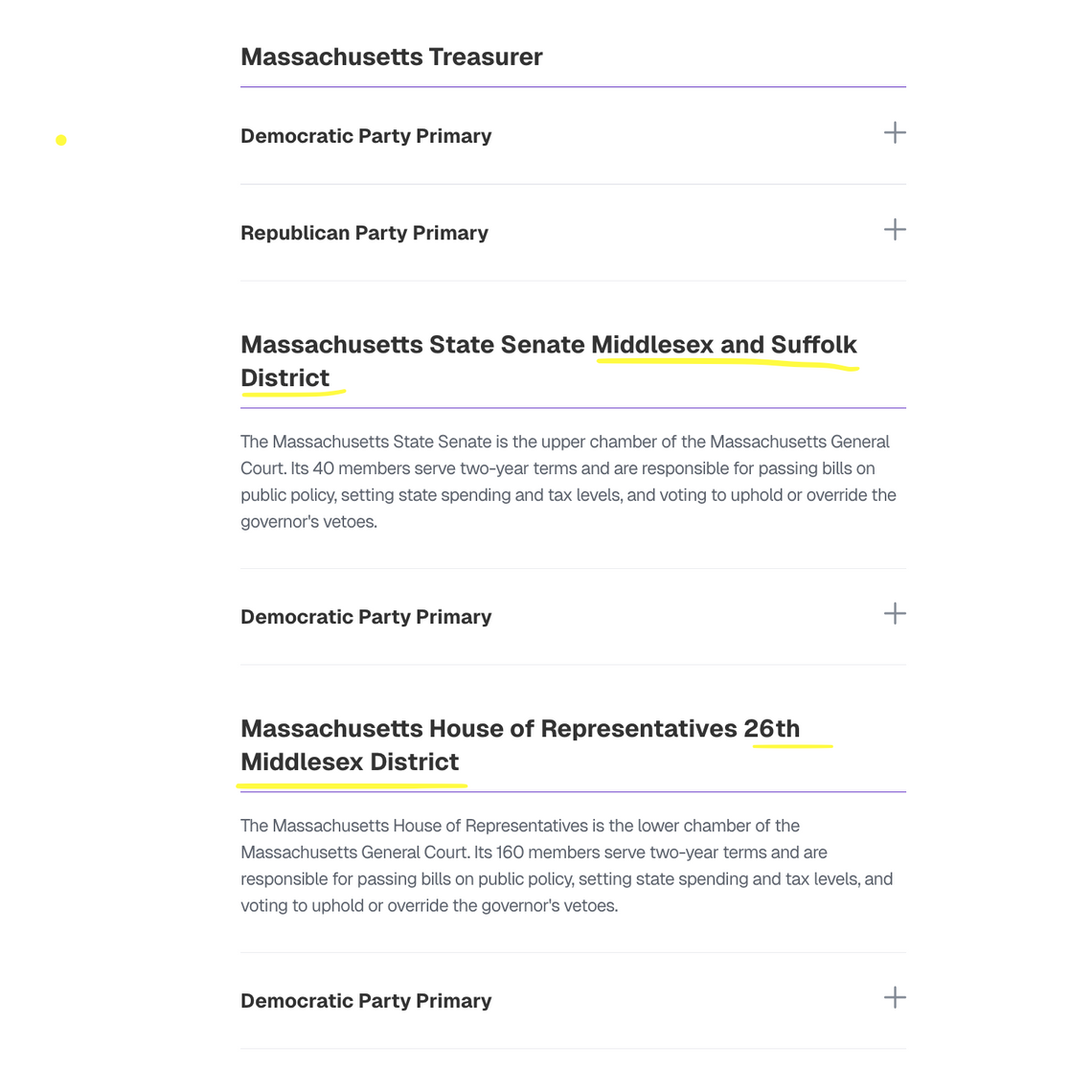
Image shows where your districts are listed on the sample ballot
Candidate Questionnaires
To help voters understand where candidates stand on hunger and food insecurity, the Make Hunger History Coalition invited candidates in contested state legislative races to answer questions about policies affecting hunger and food insecurity in the Commonwealth.
Candidates were invited to participate in contested races where more than one candidate was running for the seat. Each candidate was given 16 days to respond. Responses are presented as submitted, with only formatting edits.
Here’s how they answered.
Project Bread does not endorse candidates, but we do encourage voters interested in addressing hunger to read candidates’ responses.
Hunger & Food Policy Questionnaire Responses
U.S. Representative Candidates
-
Download Resource
John Beccia, Dan Koh & Tram Nguyen
District: 6th
-
Download Resource
Jonathan Paz & Tarik Samman
District: 5th
-
Download Resource
Jeromie Whalen
District: 1st
What am I voting for when I vote for a U.S. Representative?
Massachusetts has nine U.S. Representatives, each representing a different congressional district. When you vote for a U.S. Representative, you choose who will represent your district in the U.S. House and vote on federal laws, funding, and policies that affect food access and food security.
A U.S. Representative can:
- Vote on federal legislation that affects food and nutrition programs, including SNAP, WIC, and school meals.
- Shape federal funding for hunger relief, nutrition, agriculture, and the food system.
- Vote on policies affecting food prices, affordability, safety, and supply.
- Oversee federal agencies and programs that affect food access and security, including federal nutrition and school meal programs.
Hunger & Food Policy Questionnaire Responses
Massachusetts State Senator Candidates
Click "Show All" to view all responses
-
Download Responses
Christine Barber & Erika Uyterhoeven
District: 2nd Middlesex
-
Download Responses
Will Brownsberger
District: Suffolk & Middlesex
-
Download Resource
Joe Espinola
District: 1st Middlesex
-
Download Resource
Karen-Lipper Garbedian & Ryan O'Malley
5th Middlesex
-
Download Resource
Persis Yu
District: Norfolk & Suffolk
What am I voting for when I vote for a Massachusetts State Senator?
Massachusetts has 40 State Senators, each representing a district of about 159,000 people. They serve in the Massachusetts Legislature and vote on state laws and the annual state budget.
A State Senator can:
- Vote on state policies and laws affecting Massachusetts residents.
- Shape the state budget, including funding for universal school meals, food assistance, hunger relief, health care, education, and other programs.
- Vote on policies affecting food access, including school meals, nutrition assistance, agriculture, and food security.
- Represent the needs and priorities of their district in the State Senate.
Hunger & Food Policy Questionnaire Responses
Massachusetts State Representative Candidates
Click "Show All" to view all responses
-
Download Resource
Michelle Badger
District: 1st Plymouth
-
Download Resource
Lorena Betts
District: 16th Middlesex
-
Download Resource
Josh Bowdridge and Natalie Higgins
District: 4th Worcester
-
Download Resource
Dori Dean
District: 5th Hampden
-
Download Resource
Ben Ewen-Campen
District: 27th Middlesex
-
Download Resource
Lisa Field
District: 3rd Bristol
-
Download Resource
Nomita Ganguly
District: 24th Middlesex
-
Download Resource
Clinton Graham & Richard Wells
District: 7th Norfolk
-
Download Resource
Jen Heck
District: 18th Worcester
-
Download Resource
Tom Hendrickson
District: 3rd Hampden
-
Download Resource
Jay Higgins
District: 32nd Middlesex
-
Download Resource
Tara Hong
District: 18th Middlesex
-
Download Resource
Nicholas Lazzaro
District: 7th Worcester
-
Download Resource
Steven Leibowitz
District: 1st Barnstable
-
Download Resource
David Linsky
District: 5th Middlesex
-
Download Resource
Evan MacKay
District: 25th Middlesex
-
Download Resource
Peter Meaney & Zosia VanMeter
District: 9th Essex
-
Download Resource
Stephen Medeiros & Edward Pacheco
District: 9th Bristol
-
Download Resource
Neil Miller
District: 26th Middlesex
-
Download Resource
Connor Murray
District: 18th Essex
-
Download Resource
James O'Day
District: 14th Worcester
-
Download Resource
Angelo J. Puppolo, Jr
District: 12th Hampden
-
Download Resource
Celina A. Reyes
District: 16th Essex
-
Download Resource
Paul Ruseau
District: 34th Middlesex
-
Download Resource
Ravi Simon
District: 13th Middlesex
-
Download Resource
Ronald Waddell
District: 15th Worcester
-
Download Resource
Sarah Wilkinson
District: 5th Essex
-
Download Resource
Jadon Wilson
District: 30th Middlesex
What am I voting for when I vote for a Massachusetts State Representative?
Massachusetts has 160 State Representatives, each representing a district of about 40,000 people.
A State Representative can:
- Vote on state laws and policies affecting Massachusetts residents.
- Shape the state budget, including funding for food assistance, hunger relief, and other essential programs.
- Vote on policies affecting food access, including school meals, nutrition assistance, agriculture, and food security.
- Represent the needs and priorities of their district in the State House.